

Introduction
Risks of Publicly Listing Your Business are an important consideration for many business owners when deciding how to exit a company they have spent decades building. The decision to sell is one of the most significant moments of their professional lives.
However, once the decision to sell is made, a critical strategic choice follows: how to bring that business to market. The traditional route often involves a public listing, throwing the doors wide open to find a buyer. While this may seem like a logical way to maximize exposure, publicly listing a business can create immediate, severe, and often irreversible risks for an operating business.
In high-stakes transactions, public exposure can actively weaken your position, erode value, and jeopardize the very legacy you are trying to protect.
The Ripple Effect on Employees and Company Culture
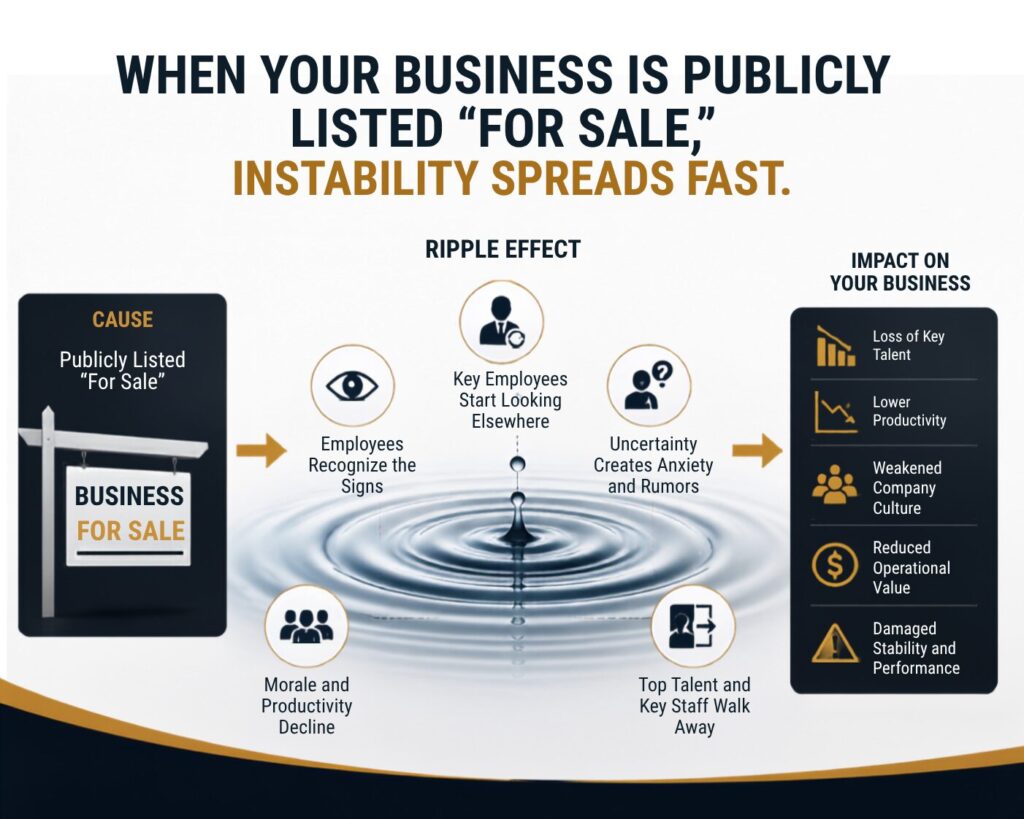
The moment a business is publicly listed as “for sale,” an invisible wave of instability ripples through the workforce. Even if the listing is semi-anonymous, employees in regional industries are highly perceptive.
It does not take long for key staff members to recognize operational descriptions, revenue ranges, or geographic details. When employees discover a sale is imminent without proper context, panic often sets in. Key executives and top-performing managers may begin quietly updating their resumes and looking for more stable opportunities.
The Risks of Publicly Listing Your Business can be seen when a sudden mass departure of essential staff directly diminishes the operational value of your company right when you need to show stable performance. Furthermore, general workplace productivity inevitably drops as speculation and anxiety replace day-to-day focus.
Competitor Exploitation and Market Vulnerability
Publicly marketing an investment asset or private enterprise acts as an open invitation for competitors to weaponize that information. Competitors can easily use the knowledge of an impending sale to destabilize your client base.
Sales teams from rival firms may approach your top accounts, planting seeds of doubt about the future continuity, service quality, or long-term viability of your operations under new ownership.
The Risks of Publicly Listing Your Business include this predatory poaching that can lead to lost accounts, shrinking margins, and a sudden drop in revenue metrics that buyers scrutinize heavily during due diligence.
Straining Vendor, Lender, and Tenant Relations

Operating businesses rely heavily on a delicate ecosystem of external partnerships. Vendors, lenders, and key suppliers react sharply to market uncertainty. If a major supplier learns your company is on the open market, they may tighten credit terms, demand upfront payments, or re-evaluate exclusive distribution agreements.
Similarly, commercial lenders and banking partners may become hesitant to extend lines of credit or approve favorable financing terms if they perceive a transition risk.
For real estate assets, commercial tenants may delay lease renewals or seek alternative spaces to avoid a change in landlord stability. These Risks of Publicly Listing Your Business can create uncertainty among critical business relationships.
The Influx of Unqualified Tire-Kickers
Open marketplaces attract an overwhelming amount of noise. Instead of fielding calls exclusively from institutional groups, family offices, or serious operators, public listings force owners to deal with unqualified buyers, curious competitors masquerading as prospects, and low-ball dealmakers.
The Risks of Publicly Listing Your Business become evident when filtering through these unvetted inquiries wastes hundreds of hours of executive time, distracting leadership from running the business and maintaining profitability during a critical period.
The Strategic Alternative: Complete Confidentiality
Protecting your business value requires a private transaction process. By bypassing the public markets entirely, business owners can quietly present their companies directly to a curated, pre-screened network of well-capitalized, qualified buyers, private equity groups, and family offices.
This ensures that your financial data and operational intent remain strictly confidential, visible only to serious principals who have signed strict non-disclosure agreements. Avoiding the Risks of Publicly Listing Your Business allows you to maintain complete control over the process, ensuring your employees, clients, and competitors learn about the transition only after the deal is securely closed.

Conclusion
The process of selling a business is not just about finding a buyer; it is also about protecting the value and reputation that has taken many years to develop.
The Risks of Publicly Listing Your Business can affect your business during this delicate period is something that you need to consider. By choosing to sell your business confidentially, you will be able to avoid any unnecessary publicity and find buyers who appreciate the real value of your business.