
Introduction
For an owner who has poured decades of vision and hard work into building a profitable company, a commercial asset, or an investment property, the traditional sale process can seem daunting, chaotic, and overly exposed. Many assume that selling a business requires a chaotic public marketing push, but a professional, institutional-grade exit operates with a entirely different philosophy. A structured private business sale process is built from the ground up to prioritize confidentiality, precision, and efficiency, moving a business from an initial evaluation to a successful close without a single day of public market exposure.
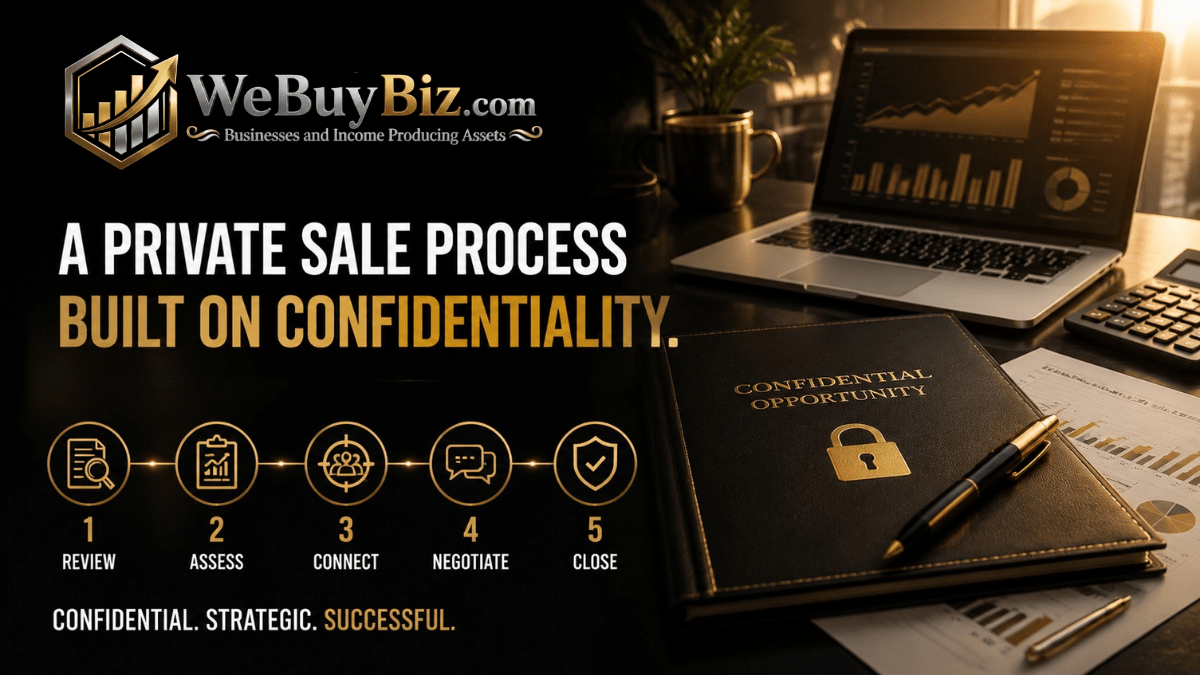
Phase 1: Starting the Private Business Sale Process with a Personal, Confidential Review
The journey begins entirely behind closed doors with a private consultation. Unlike volume-based brokerages that rely on cold algorithms to categorize operations, a true private process involves a deep, human analysis of your company’s financials, regional market position, and structural strengths. During this phase, advisors work closely with you to understand your specific transition goals, financial requirements, and ideal timeline, ensuring your numbers are properly understood before a single external conversation takes place. This is the foundation every private business sale process depends on to protect both value and confidentiality from day one.
Phase 2: Buyer Fit Assessment and Packaging
Once the core fundamentals are established, the business is cross-referenced directly against active buy-side mandates. This step is a critical checkpoint within the private business sale process, since advisors evaluate whether the business fits current, verified demand from a curated network of family offices, institutional capital partners, and independent sponsors. Concurrently, the opportunity is structured into a professional, anonymized corporate package. This documentation highlights the stable revenue, operational advantages, and strategic upside of the company while keeping sensitive identifiers entirely hidden, which is precisely why the private business sale process protects identity at every stage.
Phase 3: Targeted, Off-Market Outreach
With the blind profile securely prepared, outreach begins exclusively through private, direct channels. Because the opportunity is never published to public boards, the private business sale process introduces it quietly to pre-screened principals who have already demonstrated a clear appetite for cash-flowing operations in that specific sector.. Before any granular financial details, corporate names, or proprietary operational secrets are unlocked, buyers must pass rigorous financial verification and sign legally binding Non-Disclosure Agreements (NDAs). This filtering step keeps the private business sale process controlled, deliberate, and free of unqualified inquiries.
Phase 4: Managing Serious, principal-to-principal Conversations
By filtering out the unqualified noise and tire-kickers early on, the process accelerates straight into meaningful discussions.This is the stage where the private business sale process shows its real advantage, as owners engage directly with highly serious buyers who possess the capital, operational experience, and intent to close. This phase focuses on alignment, exploring synergies, and securing competitive Letters of Intent (LOIs) that outline fair market valuations and clear deal structures, all while day-to-day operations continue smoothly without external disruption.
Phase 5: Secure Legal Structuring and Close
When an optimal offer is selected, the transaction enters due diligence and legal execution. To guarantee maximum safety, institutional credibility, and absolute compliance, the deal must be funneled through a fully licensed business brokerage infrastructure. Professional deal coordinators, legal advisors, and M&A specialists manage the validation of files, transition structures, and closing documents. This rigorous, secure approach ensures that funds are safely wired, equity is transferred correctly, and ownership transitions cleanly—with total confidentiality maintained from the very first submission to the final handshake.
Conclusion
Deciding on a private business sale process is not only about keeping the process off the radar but also about preserving what you have built over many years with respect for its value and the people behind it. Every step along the way, from the confidential initial evaluation to the signing of the document, has one goal in mind – keeping control of the situation by screening out the unsuitable interest. For any business owner thinking of making an exit, knowledge of the private business sale process is crucial.